Cameron Main
Dice Roller Prototype
A Unity-based turn-based dice roller inspired by Yahtzee.
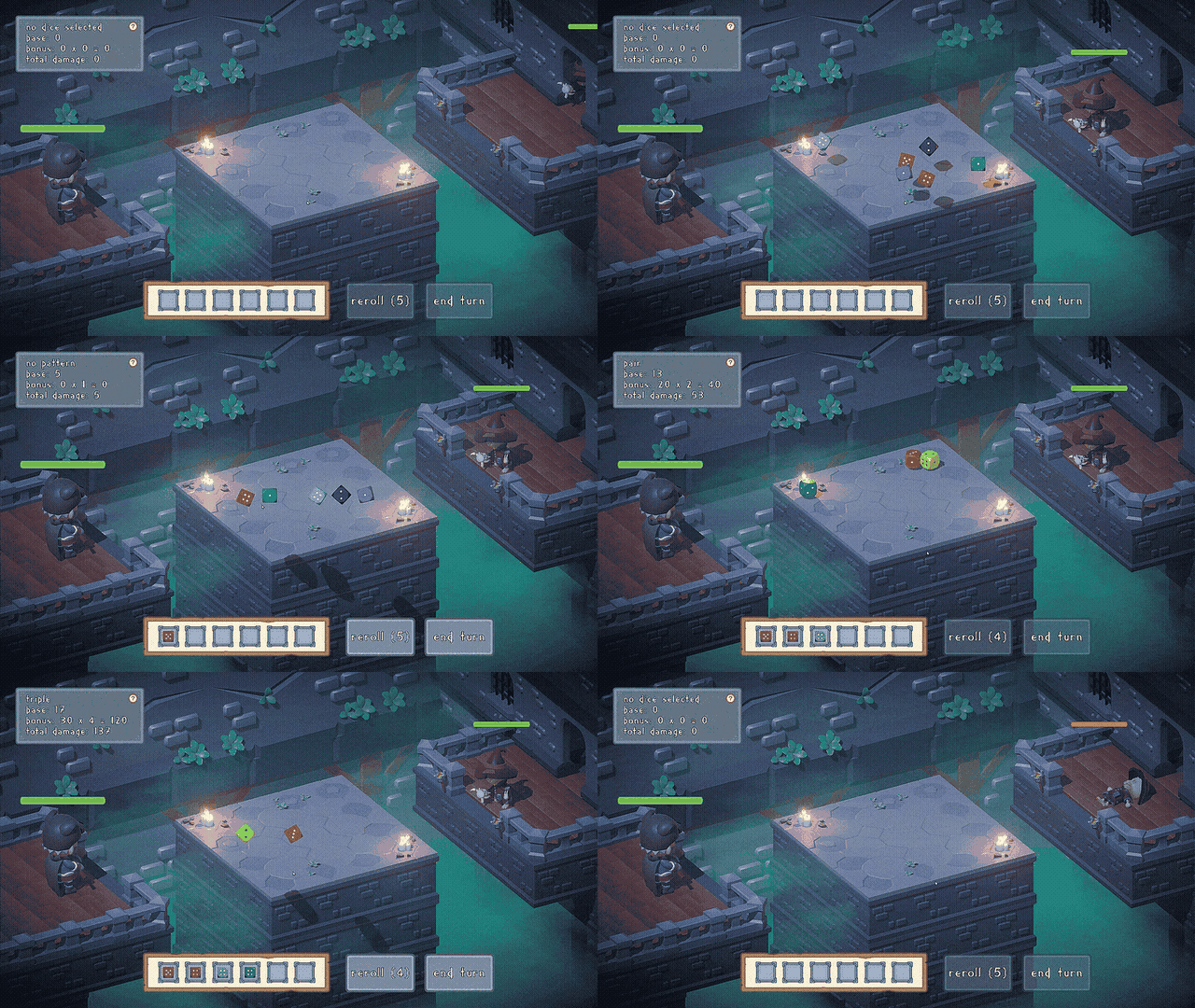 Dice rolling and scoring in action.
Key Features
- Turn-based gameplay
- Dice score calculation on 3D dice objects
- Yahtzee-inspired scoring system
- Interactive UI for dice selection and scoring
Description
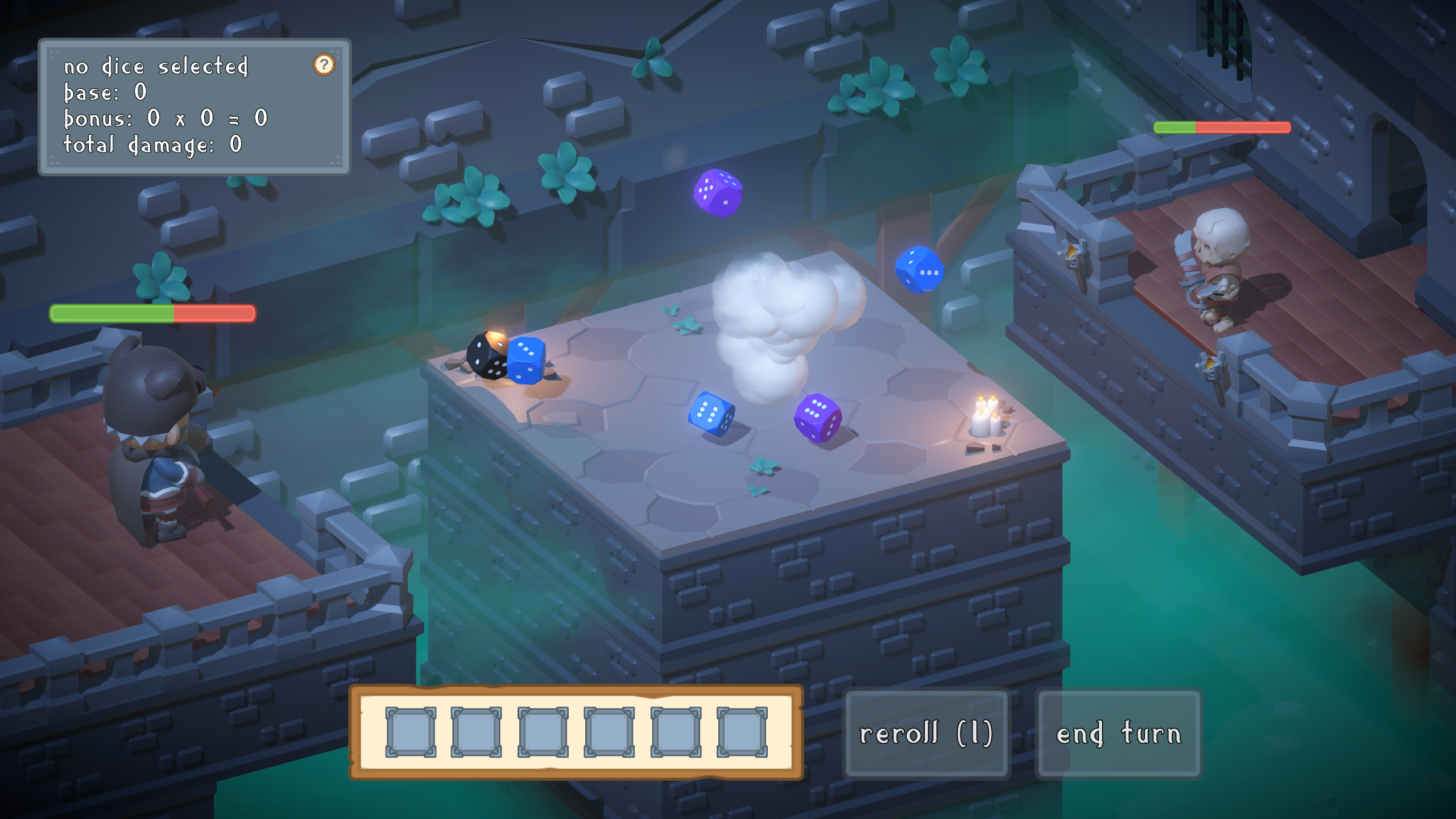
I had the idea for this spinning around in my head for a while and finally scratched the itch to make a fun prototype of it in Unity. The premise stems off trying to achieve crazy combos and attaining as high a score as you can by matching & combining dice patterns typically found in the game Yahtzee.
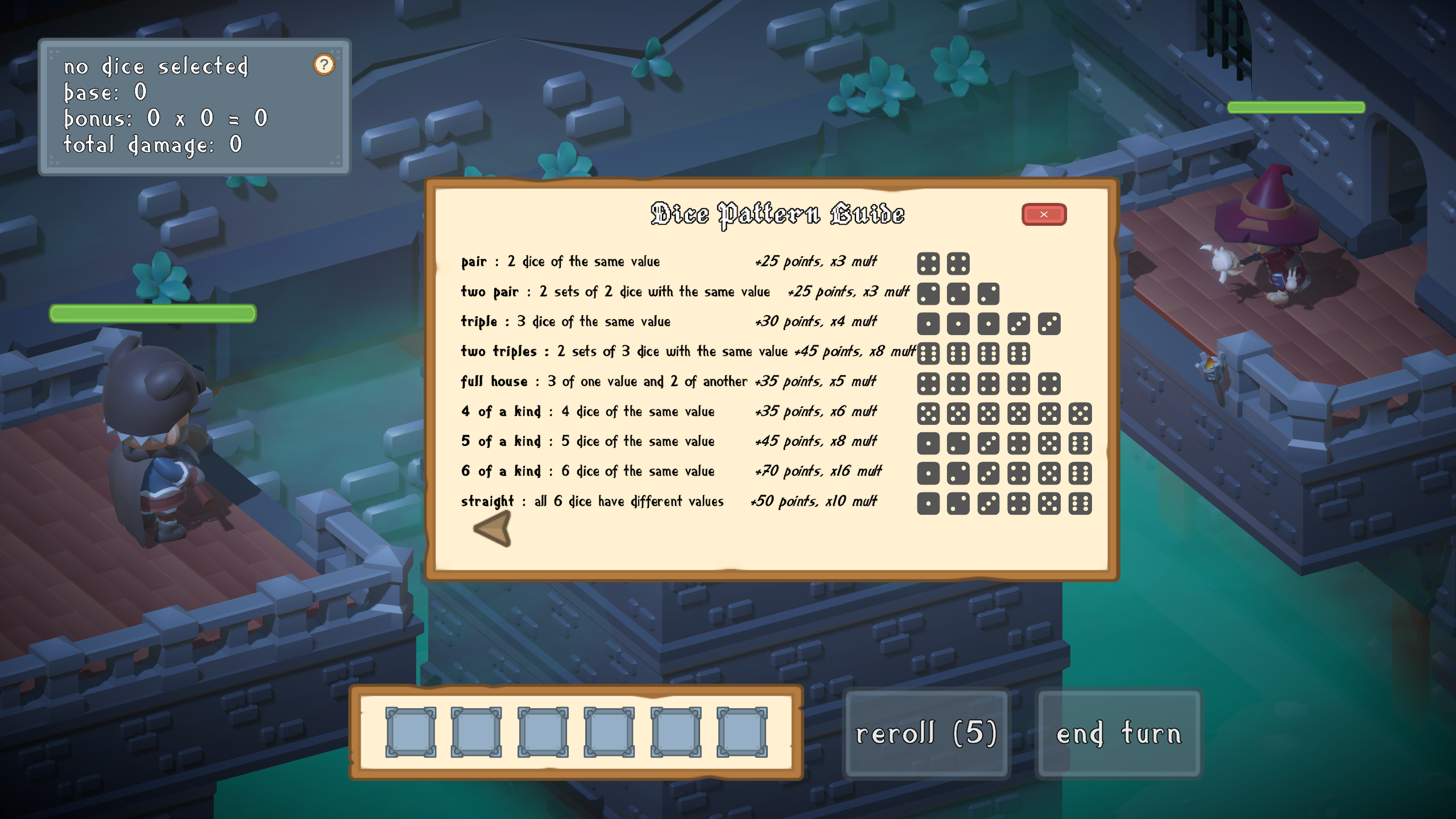
Dice Combinations and Scoring
| Combination | Description | Points | Multiplier |
|---|---|---|---|
| PAIR | 2 dice of the same value | +20 | +2x |
| TWO PAIR | 2 sets of 2 dice with the same value | +25 | +3x |
| TRIPLE | 3 dice of the same value | +30 | +4x |
| TWO TRIPLES | 2 sets of 3 dice with the same value | +45 | +8x |
| FULL HOUSE | 3 of one value and 2 of another | +35 | +5x |
| 4 OF A KIND | 4 dice of the same value | +35 | +6x |
| 5 OF A KIND | 5 dice of the same value | +45 | +8x |
| 6 OF A KIND | 6 dice of the same value | +70 | +16x |
| STRAIGHT | All 6 dice have different values | +50 | +10x |
For example, if a player rolls: 3, 3, 3, 4, 4, 6
This roll contains:
- A Triple (three 3s): 30 points, 4x multiplier
- A Pair (two 4s): 20 points, 2x multiplier
The score would be calculated as follows:
- Base score from combinations: 30 + 20 = 50 points
- Sum of dice face values: 3 + 3 + 3 + 4 + 4 + 6 = 23 points
- Total base score: 50 + 23 = 73 points
- Total multiplier: 4 + 2 = 6x
- Final score: 73 * 6 = 438 points
This score of 438 points would then be dealt as damage to the enemy.
The higher the score generated, the more damage dealt to the opposing enemy. Players can choose to gamble by rerolling, in the hopes of obtaining a die to make a higher-tiered combination, thus dealing more damage to their opponent.
The gameplay loop works via turn-based combat in which the player has a limited number of rerolls, but can gain an extra roll per enemy kill. At the end of the turn, the score generated is dealt to the enemy as damage. The enemy will then retaliate with an attack of their own (if still alive). This repeats until all enemies are defeated or the player loses all their health.
Balancing Probabilities and Points
An essential aspect of the game's design is balancing the points based on the probability of achieving different patterns. To ensure fair and engaging gameplay, I developed a Python script to simulate dice rolls and calculate the probabilities of each pattern occurring within a given number of rolls.
This simulation helped me make informed decisions about adjusting the scoring system:
- Increased the reward for harder-to-achieve patterns like 6 OF A KIND and TWO TRIPLES, as they occur less frequently than I initially thought they did.
- Slightly reduced the scoring for more common patterns like FULL HOUSE and 4 OF A KIND to balance their frequency.
- Adjusted STRAIGHT to be valuable but not overvalued, considering its rarity.
- Kept PAIR and TWO PAIR relatively low as they're common in early rolls.
- Slightly reduced 5 OF A KIND's scoring as it becomes quite common in later rolls.
Technical Challenges
One challenge I faced was determining which face of each die was facing up to attribute the correct score. While this task is straightforward for humans, implementing it in code proved to be an interesting challenge. I solved this by using a trigger collider on each face of the dice and a face detector script attached to the floor where the dice land. Once a die's velocity settles and it comes to rest, the detector activates and determines which collider it contacts. Each face is mapped to a corresponding trigger collider, returning a value attributed to the die object.
Using colliders works well for this small prototype, but a more performant method would map the rotation values of the dice to associated face values and check the die's current rotation when stationary. I initially attempted this approach, but for whatever reason the results lacked consistency. Considering the time constraints of a prototype, I decided to move away from this method and instead employ the aforementioned approach.
These adjustments helped create a more balanced and rewarding gameplay experience, encouraging players to aim for rarer patterns while still valuing more common combinations.